
The Role of Spiritual Blessing Energy Treatment in Optimizing Radish (Raphanus sativus L.). Growth and Crop Yield
Abstract
Background
Enhancing crop productivity while minimizing chemical inputs remains a core objective of sustainable agriculture. This study investigated the efficacy of spiritual blessing energy treatments as a non-invasive biostimulant to optimize the growth dynamics and crop yield of radish (Raphanus sativus L.).
Methods
Seeds and land were exposed to Spiritual Blessing Energy Treatment (SBET) in her physical presence for about 4 minutes once, alongside untreated controls under identical environmental conditions. Morphological parameters and final biomass production were systematically evaluated.
Results
Photosynthesis traits such as number of leaves per plant, leaf width, and fresh weight of leaves per plant were significantly increased by 28.41% (p = 0.003), 45.81% (p ≤ 0.001), and 28.86% (p ≤ 0.001), respectively, in the blessing/biofield energy-treated radish group (BTRSG) compared to the control radish group (CONRSG). Moreover, root length, root width/girth, and root weight per plant were significantly increased by 39.68% (p ≤ 0.001), 32.13% (p ≤ 0.001), and 30.73% (p ≤ 0.001), respectively, in the BTRSG compared to the CONRSG. Besides, root yield (tons per hectare) was increased by 46.29% in BTRSG compared to the CONRSG.
Conclusion
These findings suggest that the spiritual blessing energy treatments (Trivedi Effect®) act as a powerful biostimulatory agent capable of optimizing plant ontogeny and radish yield and offering a sustainable paradigm for precision agronomy.
Article Information
- Received
- Accepted
- Published
Academic Editor: Anubha Bajaj, Consultant Histopathologist, A.B. Diagnostics, Delhi, India
Checked for plagiarism: Yes
Review by: Single-blind
Copyright © 2026 Dahryn Trivedi, et al.
 This is an open-access article distributed under the terms of the Creative Commons Attribution License, which permits unrestricted use, distribution, and reproduction in any medium, provided the original author and source are credited.
Corresponding author: Snehasis Jana, Trivedi Science Research Laboratory Pvt. Ltd., Research and Development, Thane (W), Maharashtra, India —
Competing Interests
Author DT was employed by Trivedi Global, Inc. VDK, TBG, and NRP were employed by Shree Angarsiddha Shikshan Prasarak Mandal’s College of Agriculture, Sangulwadi, Mohitewadi, Maharashtra, India.Authors SM and SJ were employed by Trivedi Science Research Laboratory Pvt. Ltd.
Funding
The authors declare that no funds, grants, or other support were received during the preparation of this manuscript.
Data Availability
No data-availability statement was provided by the authors.
Acknowledgements
The authors are grateful to Divine Connection Foundation for the assistance and support during the work.
Citation:
Introduction
Global agricultural systems face mounting pressures due to rapid population growth, climate volatility, and the degradation of arable land 1. Maximizing the growth efficiency and overall yield of staple and speciality crops has become an urgent priority for modern agriscience 2. To mitigate the consequences of severe environmental stressors, including drought, unpredictable temperatures, and localized soil degradation, traditional farming methodologies heavily rely on chemical fertilizers and hazardous synthetic inputs 3. However, the resulting ecological damage and escalating input costs necessitate the exploration of sustainable, eco-friendly, and non-invasive agricultural alternatives that can optimize phenotypic traits and physiological pathways without introducing toxic chemical residues. In recent years, innovative agronomic technology, particularly low-level electromagnetic fields, has demonstrated a profound capacity to modulate plant photoreceptors, stimulate secondary metabolism, and enhance stress tolerance 4. Building upon these biophysical interventions, the investigation of subtle energy fields and biofield treatments has emerged as an intriguing frontier in non-traditional crop management. Subtle energy frameworks, often categorized under biofield energy healing, involve the targeted redirection of low-level, non-ionizing environmental energies to positively influence the physiological, phenological, and genetic configurations of living organisms. Among these alternative interventions, Spiritual Blessing Energy Treatment (SBET) has been systematically scrutinized for its capacity to stimulate crop vitality and prove that subtle energy can act as a viable catalyst for agricultural optimization 5, 6.
Radish (Raphanus sativus L.), an economically vital root vegetable cultivated worldwide, serves as an excellent model organism for evaluating such biophysical treatments due to its rapid growth cycle and highly sensitive root-to-shoot biomass partitioning. Given that radish root development is tightly governed by local metabolic signaling and carbohydrate distribution, understanding how blessing energy treatments modulate its growth could offer scalable insights into root-crop optimization. While the phenotypic and metabolic impacts of blessing energy have begun to be mapped in vining crops like bottle gourd, its definitive role in modulating the underground biomass, enzymatic activity, and harvest index of Raphanus sativus L. remains poorly understood. This study aimed to bridge this critical gap by evaluating the specific impacts of the spiritual blessing energy treatments on the germination, vegetative growth, and root morphology of radish (Raphanus sativus L.).
Materials and Methods
Experimental site details
This study was conducted in Bhandarwadi, Sindhudurg, Maharashtra, India (15°37’–16°40’ N, 73°19’–74°13’ E; 26 m above mean sea level) within the tropical Konkan agro-climatic zone. The site was characterized by mean maximum pre-monsoon temperatures of 39–42°C and pronounced interannual rainfall variability. These erratic precipitation patterns drive severe soil moisture deficits, thereby elevating crop vulnerability to drought stress and potentially disrupting key physiological processes during critical phenological stages.
Seed details and study design
Radish seeds (Raphanus sativus L., cv. 'Desi Golden/Pusa Chatki') with 98% genetic purity (Lot No. NURGF099) were obtained from Namdeo Umaji Agritech (India) Pvt. Ltd. The seeds were divided into two experimental groups: a control group and a treatment group, with the latter subjected to a spiritual blessing energy treatment (SBET). All agronomic and environmental conditions—including irrigation, fertilization, and pest management—were maintained uniformly across both groups throughout the study.
Field layout
The experiment followed a Randomized Complete Block Design (RCBD) consisting of two treatments replicated three times: an untreated control (CONRSG) and a biofield energy treatment (BTRSG). While the CONRSG group received no intervention, the seed stock and designated plot soil in the BTRSG group were subjected to a biofield energy treatment prior to sowing. The experimental layout comprised six plots, each measuring 2.5 m × 1.5 m (total site area of 30.0 m²). A uniform buffer distance of 0.5 m was maintained between adjacent plots and replications, with an intra-plot crop spacing of 0.5 m × 0.5 m. Prior to planting, the site was cleared, and a standard basal NPK fertilizer was applied to each plot at a rate of 50, 100, and 50 kg ha⁻¹, respectively, and thoroughly incorporated into the soil.
Spiritual blessing (prayer) energy treatment strategy
Spiritual Blessing (Biofield) Energy Treatment (SBET) was administered to the experimental group, which contained both radish seeds and soil (BTRSG), by an experienced practitioner, Mrs. Dahryn Trivedi with over 14 years of expertise. Concurrently, the control group (CONRSG), comprising identical seeds and soil, received no intervention. The SBET was applied as a single, non-contact exposure lasting approximately 4 min, with the practitioner physically present at a distance of approximately 0.5 m from the samples. Ambient environmental conditions during the application were strictly maintained at a temperature of 28 ± 2°C and a relative humidity of 65 ± 5%.
Soil features
To characterize baseline properties, composite soil samples were collected from the top 30 cm of each plot using a five-point sampling design. Samples were air-dried, homogenized through a 2-mm sieve, and stored at 4 °C. Soil particle size distribution was determined according to established protocols 7. Potentiometric pH was measured in a 1:2 (w/v) soil-to-distilled water suspension using a calibrated pH meter.
Seed plantation and farming management
After sowing, plots were manually irrigated for a 7-day establishment period prior to initiating a surface drip irrigation system. This system utilized pressure-compensating emitters spaced 0.5 m apart with a discharge rate of 3 L h⁻¹. Basal fertilization was applied at a rate of 50:100:50 kg ha⁻¹ of nitrogen (N), phosphorus (P), and potassium (K), respectively. The initial application included the full doses of P (as single superphosphate, SSP) and K (as muriate of potash, MOP), combined with 50% of the total N (as urea). The remaining 50% of N was side-dressed at 21 days after sowing (DAS). To maintain uniform experimental conditions, insect pests were managed across all treatments using a foliar application of a commercial insecticide mixture (50% chlorpyrifos + 5% cypermethrin; Hamla 550, Gharda Chemicals Ltd., Mumbai, India) at a concentration of 2 mL L⁻¹.
Growth parameters of radish
We randomly selected five plants per plot at 45 days after sowing (DAS) to measure key morphological and agronomic traits. Qualitative attributes included leaf blade color, lobing, trichome density, root shape, flesh and external color, and aroma. Quantitative metrics included plant length, leaf number per plant, leaf blade dimensions (length and width), leaf fresh weight, root length, root diameter, and total yield (t/ha).
Yield parameters of radish
Radish fruits were harvested at physiological maturity. Fruit dimensions (cm) and mass (g) were determined using a digital caliper and a precision electronic balance, respectively. Yield-contributing parameters were recorded from five randomly selected plants per plot. Net plot yield (kg) was subsequently extrapolated to tonnes per hectare (t ha⁻¹).
Statistical analysis
Continuous variables are expressed as mean ± standard error of the mean (SEM). After verifying normality and homogeneity of variance, differences between the two independent cohorts were analyzed using a two-tailed Student’s t-test. All statistical evaluations were performed using SigmaPlot (version 14.0), and the threshold for statistical significance was set at p < 0.05.
Results
Soil properties
Baseline characterization identified a strongly acidic (pH 5.01) sandy loam texture, inherently prone to low effective cation exchange capacity (ECEC) and subsequent nutrient leaching. Post-harvest analysis demonstrated that the SBET treatment successfully mitigated this acidity, elevating the soil pH to 5.90.
Morphology characteristics
The phenological progression and morphological characteristics of radish (Raphanus sativus) were systematically evaluated at predefined intervals from seed germination through vegetative growth, flowering, silique development, and final harvest (Figure 1).
Figure 1. Changes in the vegetative growth characteristics of radish (Raphanus sativus) throughout the developmental trajectory are documented in Figure 1. C: Control group; BET: Blessing/biofield energy treatment group.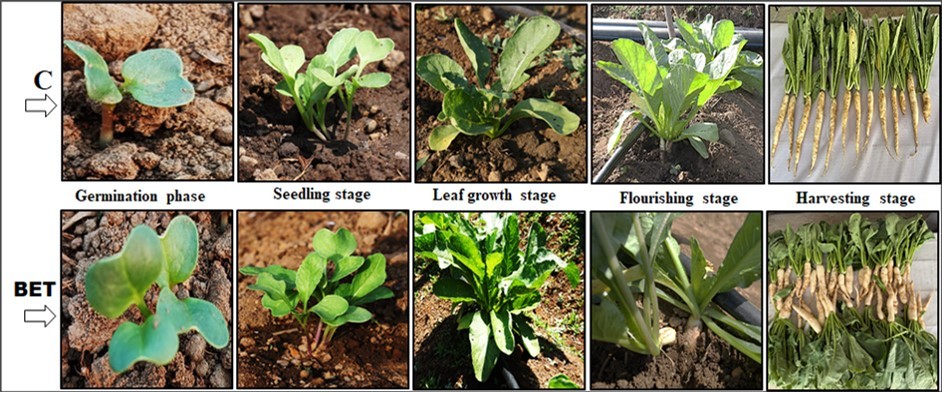
Download figure
Morphological attributes
The morphological variations in the qualitative vegetative descriptors of the radish genotypes are presented in Table 1. Foliar traits varied considerably between the two groups; BTRSG was characterized by medium leaf length (20–30 cm), wide blades (>10 cm), and a dark green coloration, whereas CONRSG exhibited short leaf length (8–20 cm), medium width (6–8 cm), and green blades. Furthermore, the leaf blades of CONRSG showed a low number of lobes and sparse hair density, while BTRSG displayed an intermediate expression for both traits. Distinct variations were also noted in root characteristics. CONRSG and BTRSG groups exhibited narrow-triangular and medium-triangular root shapes, respectively. Additionally, the root flesh of BTRSG was distinctly pungent, whereas that of CONRSG was less pungent. Several traits remained uniform across both genotypes, specifically an obtuse leaf blade apex, an entire leaf margin, and white coloration for both the root skin and flesh (Table 1).
Table 1. Effects of biofield (blessings) energy treatment on qualitative vegetative parameters of radish at 45 days after sowing (DAS).| Vegetative trait | Control group (CONRSG) | Treatment group (BTRSG) |
| Leaf length | Short (8-20 cm) | Medium (20-30 cm) |
| Leaf width | Medium (6-8 cm) | Long (>10 cm) |
| Leaf blade shape of the apex | Obtuse | Obtuse |
| Leaf blade margin | Entire | Entire |
| Leaf blade colour | Green | Dark green |
| Number of lobes in the leaf blade | Few | Medium |
| Leaf blade: density of hairs | Sparse | Intermediate |
| Root shape | Narrow triangular | Medium triangular |
| Root colour | White | White |
| Root flesh colour | White | White |
| Root smell pungency | Less pungent | Pungent |
Phenology and yield traits
The rate of germination was increased significantly by 10.59% (p ≤ 0.001) in BTRSG compared to the control, CONRSG. Photosynthesis parameters such as numbers of leaves per plant, leaf width, and fresh weight of leaves per plant were significantly increased by 28.41% (p = 0.003), 45.81% (p ≤ 0.001), and 28.86% (p ≤ 0.001), respectively, in the BTRSG compared to the CONRSG. The root length, root width/girth, and root weight per plant were significantly increased by 39.68% (p ≤ 0.001), 32.13% (p ≤ 0.001), and 30.73% (p ≤ 0.001), respectively, in the BTRSG compared to the CONRSG. Furthermore, in the BTRSG root yield (tons per hectare) was increased by 46.29% compared to the CONRSG (Table 2).
Table 2. Quantitative evaluation of the phenological and yield characteristics of radish following spiritual blessing (biofield/prayer) energy treatment.| Vegetative trait | Control group (CONRSG) | Treatment group (BTRSG) | P value |
| Days to germination | 5-7 | 5-6 | - |
| Germination percentage (%) | 86.57 ± 0.35 | 95.74 ± 0.25 | p ≤ 0.001 |
| Plant height (cm) | 29.27 ± 3.10 | 35.26 ± 3.61 | p = 0.244 |
| Number of leaves per plant | 12.04 ± 0.16 | 15.46 ± 0.82 | p = 0.003 |
| Leaf length (cm) | 21.70 ± 2.47 | 25.27 ± 1.55 | p = 0.256 |
| Leaf width (cm) | 8.12 ± 0.24 | 11.84 ± 0.42 | p ≤ 0.001 |
| Fresh weight of leaves per plant (gm) | 110.24 ± 3.15 | 142.06 ± 2.61 | p ≤ 0.001 |
| Root length (cm) | 16.48 ± 0.45 | 23.02 ± 0.96 | p ≤ 0.001 |
| Root width/girth (cm) | 4.45 ± 0.14 | 5.88 ± 0.12 | p ≤ 0.001 |
| Root weight per plant (gm) | 127.38 ± 0.34 | 166.52 ± 1.49 | p ≤ 0.001 |
| Root yield (kg)/plot | 8.04 | 11.77 | - |
| Root yield/sq. m plot (kg/sq. m) | 0.71 | 1.05 | - |
| Root yield/hectare (ton/ha) | 7.15 | 10.46 | - |
Discussion
The wide variations were observed in foliar traits between the Biofield Energy Treated Radish Group (BTRSG) and the Control Radish Group (CONRSG). BTRSG displayed medium leaf lengths, wide blades, and dark green coloration compared to the short lengths and medium widths of CONRSG, illustrating the immense vegetative polymorphism inherent to radish cultivars. This expression of varied foliar architectures aligns with the comprehensive findings reported by Manzoor et al. 2024 8, which demonstrated that leaf dimensions and color intensities serve as foundational phenotypic markers for distinguishing highly divergent radish populations. Furthermore, the intermediate expression of leaf lobes and hair density seen in BTRSG contrasted against the low lobing and sparse hair density of CONRSG highlights distinct genetic controls governing radish foliar surfaces. These complex leaf architectures and trichome density variations were tightly coupled with quantitative inheritance patterns, as documented by Yu et al. 2016 9.
In addition to above-ground vegetative traits, distinct variations were noted in the underground storage organs, with CONRSG exhibiting narrow-triangular and BTRSG displaying medium-triangular root shapes. This morphological divergence in taproot architecture reflects the deep eco-geographical and genetic diversity present within modern radish breeding lines, a phenomenon thoroughly analyzed by Kurina et al. 2021 10. The notable difference in flavor profiles, specifically where the root flesh of BTRSG was distinctly pungent whereas that of CONRSG was less pungent, can be explained by differences in secondary metabolite accumulation within the taproot tissue. According to Chae et al. 2022 radish pungency was heavily dictated by glucoraphasatin levels and its subsequent conversion into the pungent compound 4-methylthio-3-butenyl isothiocyanate (raphasatin) via the endogenous myrosinase system 11.
Collectively, these phenotypic and chemical disparities validate the successful segregation of the two groups based on targeted morphological profiles. This observation is highly consistent with the general framework established by Trivedi et al., who previously noted that localized selection pressures can dramatically alter both vegetative and organoleptic qualities in cruciferous root crops without compromising structural viability 12, 13. The experimental results demonstrate that the blessing/biofield energy treatment applied to radish seeds (BTRSG) brought about substantial improvements across all key phases of plant development, ranging from early-stage embryonic germination to vegetative leaf expansion, structural root modification, and macro-level agricultural yield when compared to the untreated control (CONRSG). The initial stage of crop establishment showed a highly significant increase in the germination rate within the BTRSG cohort. This accelerated emergence indicates that the blessing treatment effectively optimized the internal physiological triggers required to break seed dormancy and activate the embryonic axis. Accelerated germination serves as a vital indicator of enhanced metabolic priming, ensuring uniform seedling stands and minimizing vulnerability to early-stage soil pathogens. This biological acceleration matches the foundational radish germination dynamics analyzed by Kanjevac et al. 2022 14, which establishes that the precise regulation of seed metabolic events directly dictates the synchronization, velocity, and ultimate success of early-stage radish seedling development.
Following successful emergence, the vegetative architecture of the treated plants underwent significant structural enhancement. Photosynthetic capacity was closely linked to canopy development, and the BTRSG group exhibited an increase in the number of leaves per plant, complemented by expansion in leaf width. This substantial wideness of the leaves, combined with an increase in the fresh weight of leaves per plant, suggests a higher cellular density and an expanded surface area available for light interception. The relationship between external physiological triggers and the resulting phenotypic leaf adjustments of radish crops was supported by the findings of Kafka et al. 2024 15, who confirmed that modulating early metabolic signals alters structural tissue development, leading to observable variations in cotyledon formation, leaf morphology, and fresh vegetative biomass accumulation in Raphanus sativus. The observed enhancements in the foliar canopy directly match the dramatic expansions found within the underground sink tissues. In this study, the root length rose, root width/girth enlarged, and individual root weight per plant grew in the BTRSG group. This simultaneous increase in length and girth indicates balanced horizontal and vertical cellular expansion within the succulent hypocotyl tissue, allowing the plant to maximize nutrient and water uptake from the soil profile. Ultimately, these structural optimizations culminated in a massive boost in total commercial root yield (measured in tons per hectare) over the untreated CONRSG plots. This pattern of structural root development and corresponding biomass transgression was highly consistent with the radish cultivation models described by Sinyavina et al. 2023 16.
Conclusion
In conclusion, BTRSG significantly enhances both the vegetative and agronomic profiles of radish compared to the control (CONRSG). This vegetative vigor directly correlates with robust root system development, culminating in a significant increase in total root yield (t/ha). These findings underscore the transformative potential of BTRSG as a highly effective agricultural intervention to maximize crop productivity and support sustainable intensification goals.
Abbreviations
- SBET: spiritual blessing energy treatment
- CONRSG: control radish group
- BTRSG: biofield energy-treated radish group
- SSP: single super phosphate
- MOP: muriate of potash
References
- 1.Watts D, Palombo E A, Jaimes Castillo A, Zaferanloo B. (2023) Endophytes in agriculture: Potential to improve yields and tolerances of agricultural crops. Microorganisms 11(5), 1276-10.
- 2.Richards R A. (2000) Selectable traits to increase crop photosynthesis and yield of grain crops. Journal of Experimental Botany 51, 447-58.
- 3.Samynathan R, Venkidasamy B, Ramya K, Muthuramalingam P, Shin H et al. (2023) A recent update on the impact of nano-selenium on plant growth, metabolism, and stress tolerance. Plants (Basel) 12(4), 853-10.
- 4.Levitt B B, Lai H C, Manville A M. (2021) Effects of non-ionizing electromagnetic fields on flora and fauna, Part 2 impacts: how species interact with natural and man-made EMF. Reviews on Environmental Health 37(3), 327-406.
- 5.Branton A, Gaikwad T B, Phutankar N R, Kadam V D, Mondal S et al. (2026) Unveiling the influence of spiritual blessing energy treatment on the cultivation, growth and production of bottle gourd (Lagenaria siceraria L.). International Journal of Agriculture and Technology 6(2), 1-5.
- 6.Trivedi M K, Gaikwad T B, Kadam V D, Phutankar N R, Mondal S et al. (2026) Growth and yield of summer squash, green zucchini (Cucurbita pepo L.) as influenced by the application of spiritual blessings (Biofield) energy treatment (SBET). Global Journal of Food Science and Technology 14(4), 1-7.
- 7.Richer-de-Forges A C, Arrouays D, Chen S, Dobarco M R, Libohova Z et al. (2022) Hand-feel soil texture and particle-size distribution in central France. Relationships and implications. CATENA 213, 106155-10.
- 8.Manzoor A, Naveed M S, Hussain T, Ali I, Akram M T et al. (2024) Morphological characterization and analysis of genetic variability in radish (Raphanus sativus) genotypes for important qualitative and quantitative traits. Brazilian Archives of Biology and Technology 67(1), 1-12.
- 9.Yu X, Choi S R, Dhandapani V, Rameneni J J, Li X et al. (2016) Quantitative trait loci for morphological traits and their association with functional genes in Raphanus sativus. Frontiers in Plant Science 7, 255-10.
- 10.Kurina A B, Kornyukhin D L, Solovyeva A E, Artemyeva A M. (2021) Genetic diversity of phenotypic and biochemical traits in VIR radish (Raphanus sativus L.) germplasm collection. Plants 10(9), 1799-10.
- 11.Chae S H, Lee O N, Park H Y, Ku K M. (2022) Seasonal effects of glucosinolate and sugar content determine the pungency of small-type (Altari) radishes (Raphanus sativus L.). Plants (Basel) 11(3), 312-10.
- 12.Trivedi M K, Branton A, Trivedi D, Nayak G, Mondal S C et al. (2015) Evaluation of plant growth, yield and yield attributes of biofield energy treated mustard (Brassica juncea) and chick pea (Cicer arietinum) seeds. Agriculture, Forestry and Fisheries. 4(6), 291-295.
- 13.Trivedi M K, Branton A, Trivedi D, Nayak G, Gangwar M et al. (2015) Agronomic characteristics, growth analysis, and yield response of biofield treated mustard, cowpea, horse gram, and groundnuts. International Journal of Genetics and Genomics 3(6), 74-80.
- 14.Kanjevac M, Jakovljević D, Todorović M, Stanković M, Ćurčić S et al. (2022) Improvement of germination and early growth of radish (Raphanus sativus L.) through modulation of seed metabolic processes. Plants 11(6), 757-10.